
About us
The world is now facing a deep crisis in fundamental principles of fairness and solidarity of a rights-based approach to health and broader development gains which lead to a break-down in trust among stakeholders and further attribute to vulnerable communities. Building up coalitions of like-minded individuals, institutions and organisations who share a similar value system and a track record of real accomplishments over time is important to overcome these challenges. There are three shifts that are particularly of concern for the global health and welfare: escalating harm to human societies and the planet and the environment, growing inequality across countries, and finally rising complex governance.
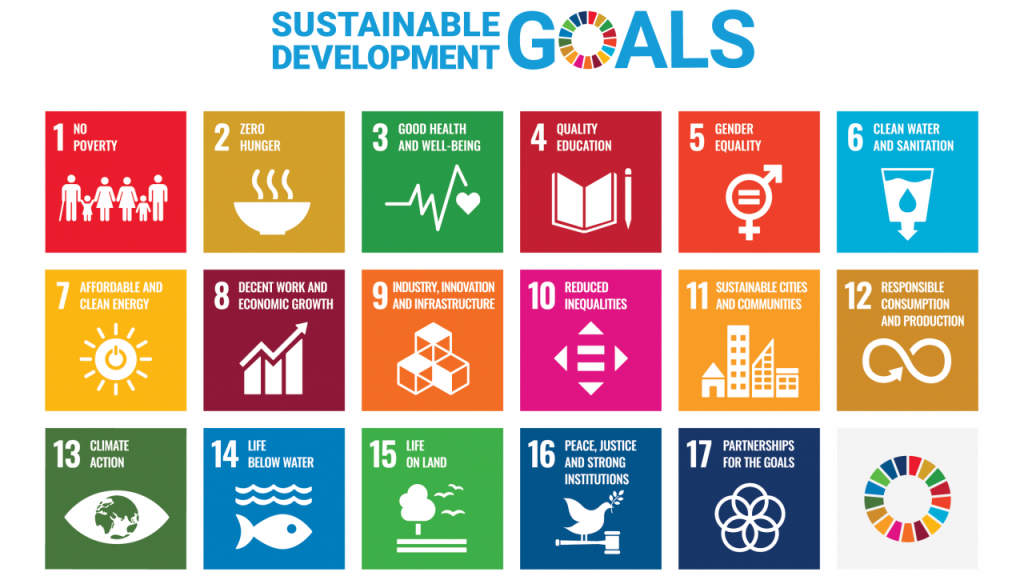
The term “Global Health” in the name of the Center recognizes the globality of public health which considers the formalized and systematized process. The center will draw from many disciplinary possibilities available at PSU. At initial initiative, eight Faculties including the Faculty of Medicine, Faculty of Nursing, Faculty of Dentistry, Faculty of Pharmaceutical Sciences, Faculty of Veterinary Science, Faculty of Science, Faculty of Engineering, and Faculty of Agro-Industry have agreed upon to build this partnership under the Center addressing health related issues, generating evidence and creating innovative approaches.
Mission and Aims
Mission
The Center is initially formulated from the dream and passion to help the population in the global village we are living in by protecting vulnerable health and enhancing the welfare of people living in a country, in the region and world. The public health, social development and human security of the wider society globally will be enhanced and sustained.
Aims of the Center
- To enhance the University’s own research and innovations initiatives to contribute to regional and global efforts through south-south, north-south and triangular institution and organizational collaboration in monitoring epidemiological transition at national, regional and global level.
- To develop a common collaborative research and innovation agenda and conduct research to generate empirical evidence in support of universal health coverage and managing well future epidemics and mitigate is impact on live and livelihood.
- To build national, regional and global technical knowledge, skills and competencies for research and innovations and its translation into policies, strategies and programmes.
Framework
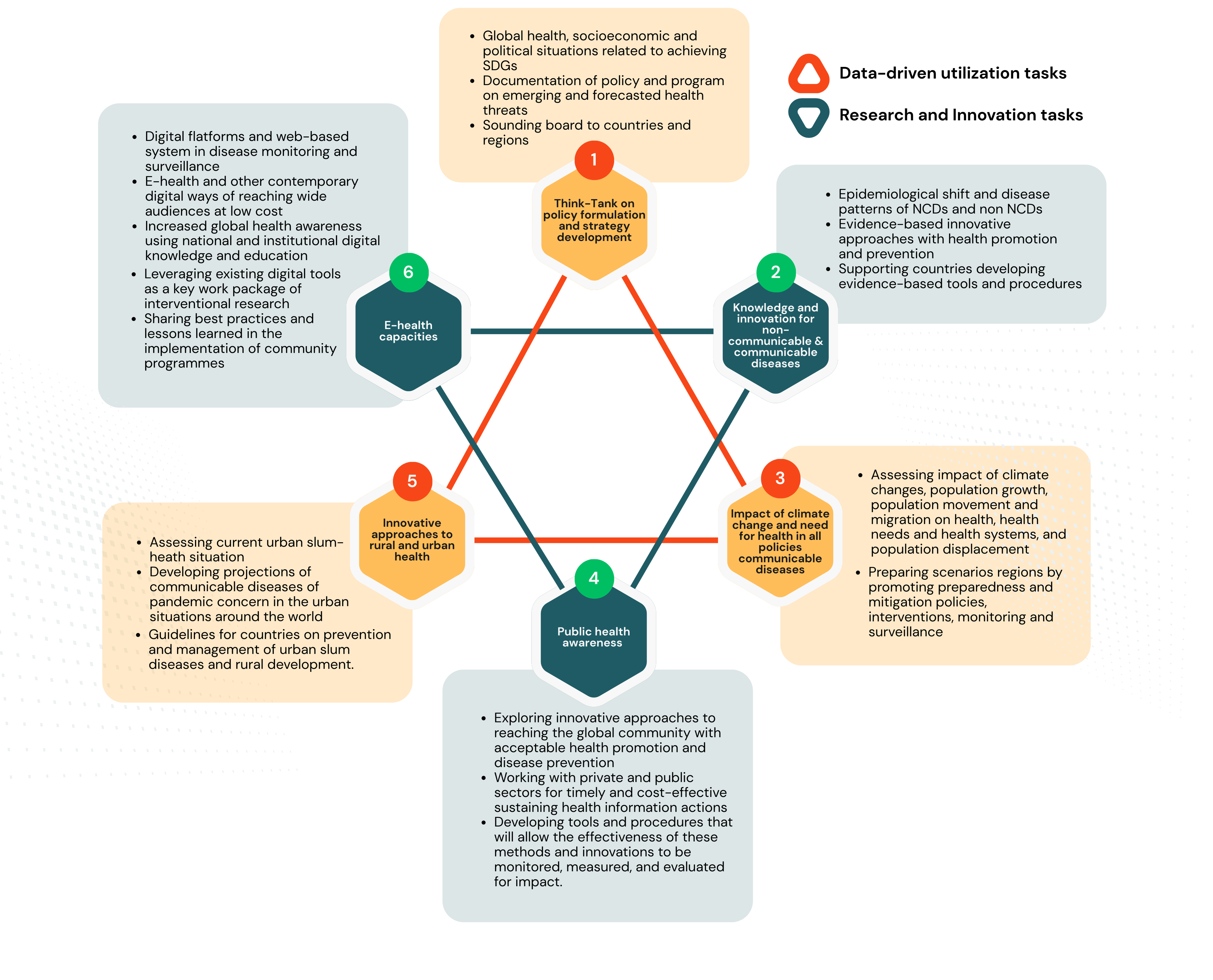
The center will produce two main tasks: data-driven contributions and research projects in terms of research and innovation for global health which 5-year initial phase will emphasize on the diseases affected by climate changes in non-communicable and communicable diseases. For research projects, the main theme will be the collaborative network of multi-sectoral approaches for reducing diabestes mellitus and vector-borne diseases: from diagnosis, treatment to prevention & control. This set of projects has been established from the discussion across 8 faculties of this initaitative.
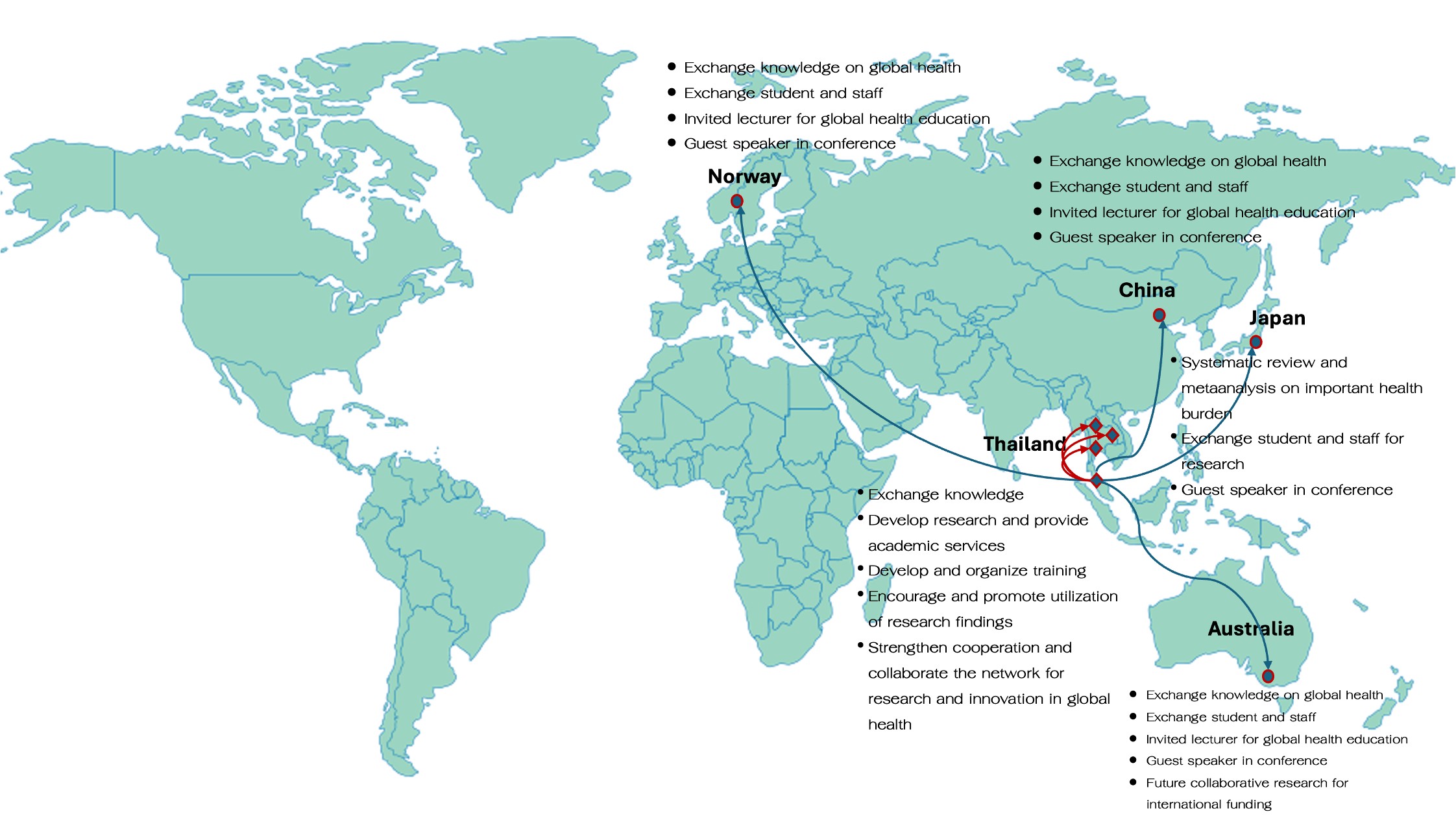
C-GHRi international Recognition and international collaboration for research and network
The center will produce two main tasks: data-driven contributions and research projects in terms of research and innovation for global health which 5-year initial phase will emphasize on the diseases affected by climate changes in non-communicable and communicable diseases. For research projects, the main theme will be the collaborative network of multi-sectoral approaches for reducing diabestes mellitus and vector-borne diseases: from diagnosis, treatment to prevention & control. This set of projects has been established from the discussion across 8 faculties of this initaitative.